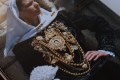







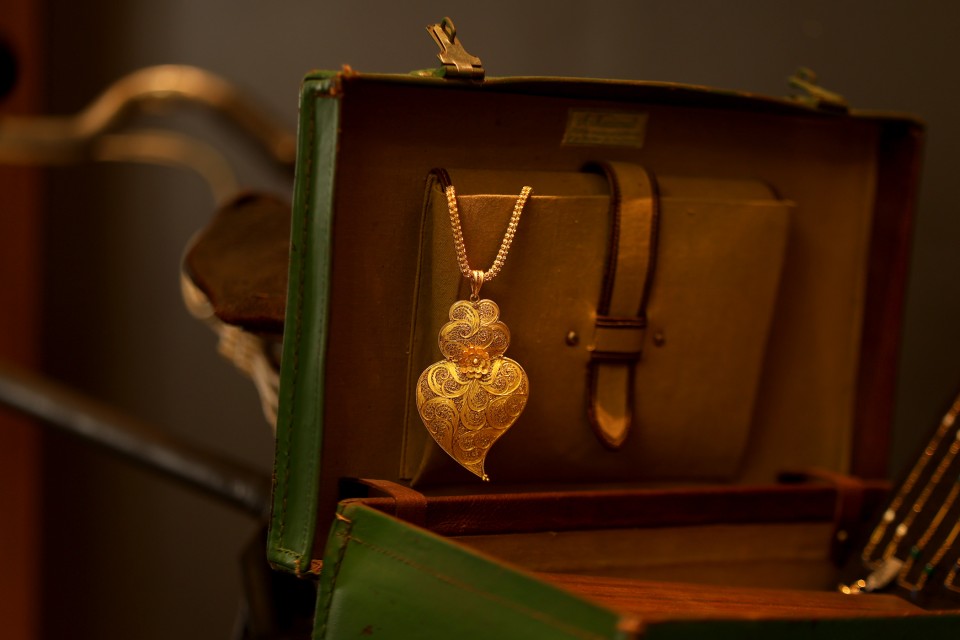
Some jewellery is worn. Some is inherited, kept in a velvet box and taken out only on the days that matter. The Coração de Viana, the Heart of Viana, belongs to the second kind.
If you have travelled through Portugal, you have seen it: on the costumes of the summer religious festivals, around the necks of brides, in old family photographs, and increasingly on people who simply want to carry a piece of this country with them. Behind that familiar shape, however, lies a technical, symbolic and geographical story that very few visitors ever hear in full.
A sacred symbol that is also a worldly one
The flaming heart has centuries of tradition behind it. It stands for the warmth of faith, for charity and for love of one's neighbour. At the same time it is a thoroughly worldly symbol: burning love, pure affection and fertility.
That double reading explains much of its power. As the vital organ of the body and the seat of the soul, the heart won a unique place on the chest of Portuguese women. It was the farming women of the Minho and the Douro Litoral, in the north of the country, who favoured the filigree hearts, either double-sided or single-faced, and these were made mostly in the workshops of Gondomar and Póvoa de Lanhoso.
Anatomy of a filigree heart
Seen up close, the Heart of Viana is not one single shape. It is three elements, read from the top down.
- The flaming crown. The top of the piece stylises a flame: of faith, of ardent love, or of intensity of feeling in general.
- The central flower. The hinge element, joining the body of the heart to the filigree flames above it.
- The heart itself (the base). Recognisable by its asymmetrical curve and by the precision of the filigree lacework.
It is that last part that separates a good piece from an exceptional one. The word filigree joins two Latin terms, filum (thread) and granum (grain), and describes an ancient art of patience and precision: two extremely fine threads of precious metal are twisted, shaped over a structure and soldered together, creating metal lace of rare beauty.
The geographical myth: most so-called "Viana" jewellery was never made in Viana
This is the fact that tends to surprise people the most when they walk into the shop.
Although the name of several of these pieces is inseparably linked to the district of Viana do Castelo, in the far northwest of Portugal, the overwhelming majority were never made in the Minho region at all. Historically, production was concentrated in the workshops of Braga, Póvoa de Lanhoso, Porto and Gondomar. The finished pieces were then sold into the Minho, where local women adopted them as the noblest element of their traditional dress.
It was the Alto Minho that gave these pieces their status, buying them and displaying them at the romarias, the region's religious festivals and pilgrimages. One region made them; the other gave them meaning. The road between the two was carried on the shoulders of travelling salesmen. That is how the gold of the north reached the rest of the country, Sintra included.
Why Portuguese gold looks different
A Heart of Viana bought in Portugal has a colour that is hard to find anywhere else.
Most European countries work gold at 9 carats (375 parts per thousand), 14 carats (585) or 18 carats (750). Portugal keeps, by tradition, a purity of 19.2 carats, which is 800 parts per thousand of pure gold. That unusually high concentration is what gives Portuguese pieces their characteristic warm, vivid, solar yellow, a colour that never darkens and never loses its shine.
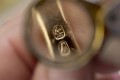
No gold item weighing more than half a gram reaches the counter without first passing through the Contrastaria Portuguesa, the Portuguese assay office. The hallmark is compulsory and guarantees the purity of the metal.
Read on: the complete guide to traditional Portuguese goldsmithing
The Heart of Viana is only one of the icons of Portuguese goldsmithing. There are also the arrecadas or "bambolinas" earrings, the Viana beads known as "partridge eye", the Queen's earrings, the caramujos, the engraved "Lembrança" keepsake medals and the "baroque" stamped pieces, each with its own technique, meaning and moment in history.
We have gathered all of it, including an explanation of the certification mark created in 2018 for handmade filigree, on a dedicated page:
Traditional Portuguese Goldsmithing: the complete guide
See it in person, in Sintra
After 25 years on the road on his Florett moped, Reinaldo Arneiro settled in 1969 in the heart of the historic village of Sintra. He never gave up meeting customers directly at the traditional markets of Malveira, Cascais and São Pedro, and the shop became the home base where the Portuguese gold tradition is celebrated every day.
Jewellery is memory made solid. These pieces hold the social and aesthetic values of their time. On the first floor, directly above the shop, you can see in person every piece mentioned here and many more, each with a story of its own. Entry is through the shop, and you are welcome to take as long as you like.
Arneiro 1969 Praça da República, 21-22, 2710-616 Sintra, Portugal Monday to Saturday, 10:00–13:00 | 15:00–19:00 www.arneiro.com