







A piece is genuine when three things can be confirmed independently: the metal (the type and fineness, guaranteed by the Assay Office marks), the stones (nature, origin and treatments, attested by a gemmological report) and the technique or authorship (for example, certification of handmade filigree). In Portugal, the first and most reliable step is always the same: look for the legal marks struck into the piece.
This guide shows you exactly what to look for, how to interpret what you find, and who to turn to when doubt remains.
What "genuine" really means, and why the question is misleading
Most misunderstandings in the jewellery trade stem not from fraud, but from imprecise language. A piece may be:
- Solid gold of a given fineness (19.2 kt, 18 kt, 9 kt…);
- Gold-plated silver (925 silver with a gold finish), frequently mistaken for gold;
- Genuine in its metal, but set with synthetic or treated stones that have not been declared;
- Genuine in its materials, but industrially made and sold as handmade, the classic case with filigree.
Step 1: look for the legal marks on the piece
The Portuguese legal framework for the jewellery trade and assay offices (RJOC), enacted by Law no. 98/2015 of 18 August and amended by Decree-Law no. 120/2017, sets out when an article containing precious metal is legally marked. At a minimum, it requires:
- The sponsor's mark (also known as the maker's mark), a punch with a unique and exclusive design belonging to the trader, approved and registered with the Assay Office. It is the signature of whoever placed the piece on the market.
- The assay mark, struck by the Assay Office of the Imprensa Nacional-Casa da Moeda (INCM) after testing the metal, together with the fineness mark in numerals, where the former does not already include it.
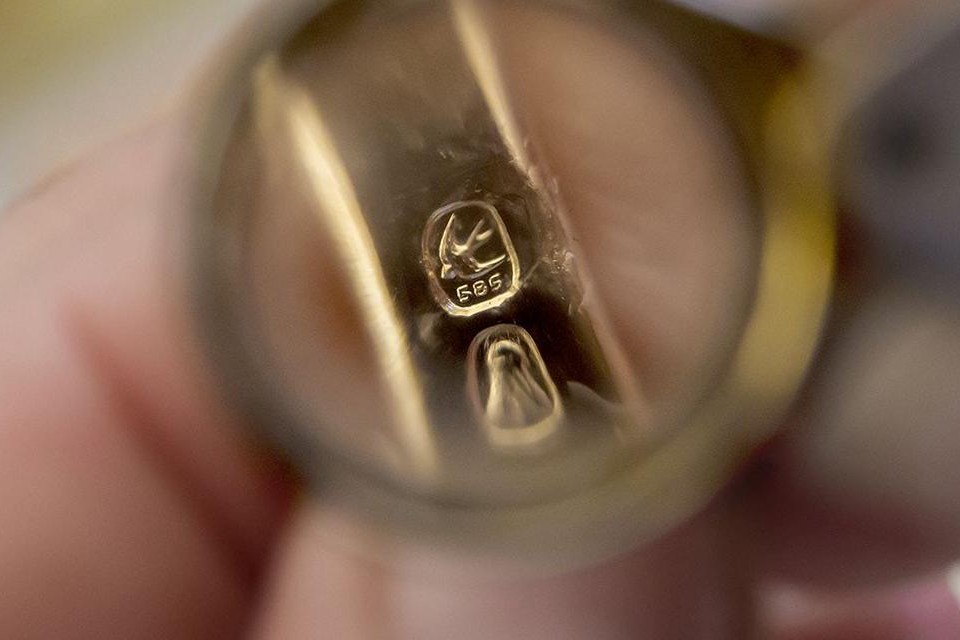
These marks are tiny. Use a 10x loupe and look in discreet places: inside the band of a ring, on the clasp of a necklace or bracelet, on an earring post, on the bail of a pendant.
Legal fineness standards in Portugal
"Fineness" is the proportion of precious metal in the alloy, expressed in parts per thousand. In force since 1 January 2021:
| Metal | Legal Fineness (‰) | Equivalent |
|---|---|---|
| Gold | 999, 916, 800, 750, 585, 375 | 24 kt, 22 kt, 19.2 kt, 18 kt, 14 kt, 9 kt |
| Silver | 999, 925, 835, 830, 800 | 925 = prata de lei / sterling |
| Platinum | 999, 950, 900, 850 | — |
| Palladium | 999, 950, 500 | — |
Portuguese 19.2 kt gold corresponds to a fineness of 800‰: 80% pure gold and 20% other metals (usually silver and copper). It is a higher standard than the 18 kt (750‰) more common elsewhere in Europe, and the reason why an authentic Portuguese piece has a warmer colour and a higher specific weight.
How to read the assay mark
Each metal has its own animal, and the direction the head faces indicates the group of standards (the latest version was updated in 2021)
- Gold: a ram's head facing left for 999, 916 and 800; facing right for 750, 585 and 375.
- Silver: a rabbit's head facing left for 999 and 925; facing right for 835, 830 and 800.
- Platinum: a hummingbird's head facing left.
- Palladium: a lynx's head facing left.
The outline of the punch also identifies which Assay Office carried out the marking (Lisbon or Porto).
What if the marks look different? The piece is probably older
Older marks are not a sign of forgery. They are an excellent indication of authenticity and they allow the piece to be dated:
- A stag's head with "800" corresponds to 19.2 kt gold marked between 1985 and 2020.
- An ant corresponds to 800‰ white gold, between 1938 and 1984 (a specific mark discontinued in 1985).
- An eagle's head corresponds to silver under the pre-2021 system.
Pieces bearing marks from discontinued municipal assay offices may even be worth more to collectors. If you have inherited a piece of jewellery with marks you do not recognise, compare them against the official table of marks before assuming the worst.
Note: some pieces are legally exempt from hallmarking
The absence of a hallmark does not prove that a piece is fake. Exempt from marking are articles of gold or platinum with a total weight of 0.5 grams or less and articles of silver of 2 grams or less. Very small earrings, light pendants and certain fine components fall into this category, and are sold legally without an assay punch.
Step 2: assess the seller (the quickest test of all)
Before examining the piece, examine who is selling it. The law imposes very specific obligations on any jeweller, whether physical or online. In a shop selling precious metals, you should find:
- Details of the metal, the fineness and the weight of each piece, and of any gemmological materials set into it;
- A copy of the official table of Assay Office marks, on display;
- An express statement that, should the buyer have any doubt as to the authenticity of the marks, they may refer the piece to the Assay Offices;
- The trader's activity licence.
The same requirements apply to distance and catalogue sales, with the necessary adjustments: a reputable online shop publishes the fineness, the weight and its licence number, and provides the table of marks or a link to the INCM website.
Step 3: check the stones, not just the metal
An authentic metal can hold a stone that is not what it appears to be. For diamonds and stones of significant value, you may ask for a gemmological report from an independent, recognised laboratory — GIA, IGI or HRD Antwerp — where applicable. A current report expressly distinguishes a natural diamond from a laboratory-grown one (lab-grown), as well as noting any treatments. A lab-grown diamond is not a fraud; it is a legitimate product with a price of its own. The fraud lies in not declaring it.
International certification and in-house certification: the difference worth knowing
Not every piece with stones comes with a GIA or IGI report, and that is no indication of lesser quality.
At Arneiro 1969, every piece is accompanied by an in-house certificate, issued on the basis of the technical documentation and the certificates provided by the respective manufacturers, identifying the metal, the fineness, the weight and the characteristics of the stones.
We also carry diamond rings that are accompanied by international GIA or IGI certification, issued by an independent laboratory.
The distinction matters: an in-house certificate is a statement of responsibility by the seller, supported by the documentation of whoever made the piece; a GIA or IGI report is an analysis carried out by a third party. Both are legitimate and both have value.
Step 4: technique and authorship: the case of filigree
With a filigree piece, the question "is it genuine?" is almost never about the gold, that is guaranteed by the hallmark, as we have seen. It is about knowing whether it was made by hand, wire by wire, or whether it is an industrial reproduction cast from a mould.
The "Filigrana de Portugal" certification
There is a certification created to answer precisely that question: "Filigrana de Portugal", with the stated aim of protecting artisans from industrial imitations. It is awarded by a body accredited by the Portuguese Accreditation Institute (A.Certifica) and takes two forms: a punch on the piece itself and a guarantee label bearing the name of the artisan who made it. Since 2024, applying the certification mark has been the exclusive responsibility of the INCM Assay Office, under a protocol with the municipalities of Gondomar and Póvoa de Lanhoso and with the certifying body.
The label also distinguishes three categories, which substantially affect the value of a piece:
- 100% filigree, where the entire piece is handmade filigree work;
- Filigree, where more than 50% of the visible area is filigree work, on a gold and/or silver base;
- Filigree application, where the filigree elements are entirely handmade but sit on bases or techniques using other materials.
What the absence of certification does (and does not) mean
A piece can be genuinely handmade and carry no certification at all. This is an essential point, and one that is frequently explained badly.
The "Filigrana de Portugal" certification programme began in July 2018 with some 21 participating workshops, and the number of certified workshops remains small relative to the total number of artisans working today: the National Inventory of Intangible Cultural Heritage records 17 participating companies. To this must be added every piece made before 2018 and the vast body of family jewellery passed down through inheritance.
The "Filigrana de Portugal" punch proves that a piece is handmade; its absence proves nothing. Treat it as a welcome confirmation, never as grounds for exclusion.
Handmade filigree is built wire by wire onto a frame and joined with solder; it is never cast from a mould. One difference can visible to the naked eye: the design has small variations from one coil to the next and catches the light unevenly, whereas an industrial reproduction is geometrically uniform with a homogeneous, almost flat shine; and the piece is surprisingly light for the volume it appears to have, because the empty spaces between the wires are part of the technique.
If you are in doubt about a piece with sentimental or financial value, a goldsmith you trust can help you tell the difference.
The filigree techniques were recognised in 2023 by the Directorate-General for Cultural Heritage as Intangible Cultural Heritage, and an application for UNESCO Intangible Cultural Heritage of Humanity status is currently under way.
How to obtain a definitive answer
- Refer the piece to the Assay Office. The law expressly provides that a buyer with doubts about the authenticity of the marks may refer the piece to the Assay Offices for verification. The INCM Assay Office also provides expert examination services for precious metal articles.
- Consult an official appraiser. The INCM maintains the register of legally qualified appraisers of precious metal articles and gemmological materials. Appraisers are liable to injured parties for errors made in their valuations.
Conclusion
Knowing what you are buying is simpler than it seems: the marks on the piece tell you the metal and the fineness, the report tells you what the stone is, and the label tells you how it was made. This information exists, and any jeweller should be able to explain it.