







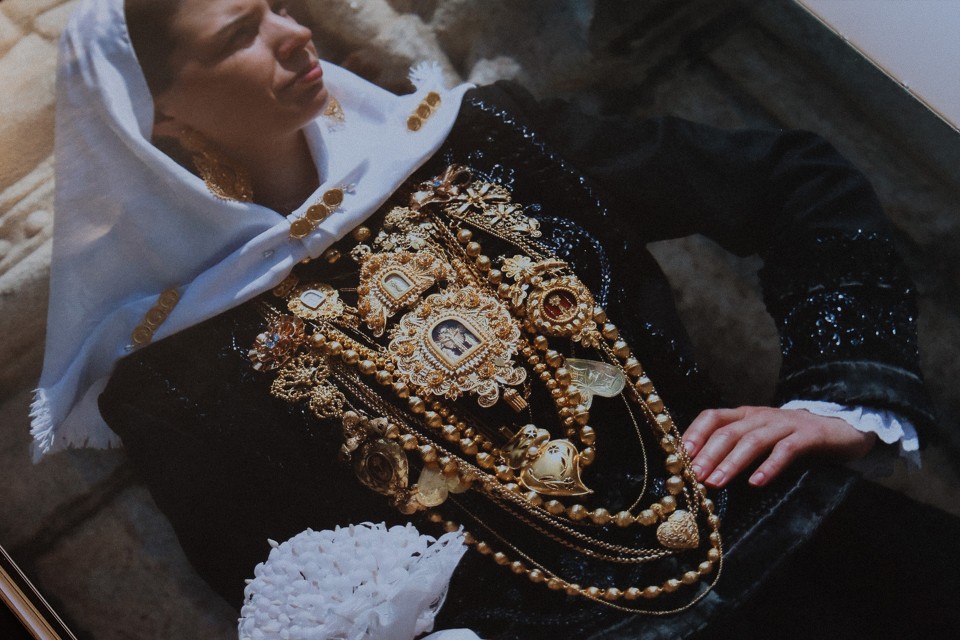
For more than a century, a bride from the Minho was married in black and wore her family's gold across her chest.
The white dress came later, through foreign influence. Until then, and for a long time afterwards, a wedding day followed a different grammar: a dark costume embroidered with sequins, and over it an arrangement of gold pieces assembled according to rules that anyone in the region could read.
The bridal costume was set apart by two details
In the processions of Viana do Castelo you can still see the rich costumes: that of the prosperous farmer's wife, the mordoma (the woman who leads the festival), the bride and the morgada (the heiress). Among these, the black costumes of the mordoma and the bride are almost identical. The difference lies in two things alone. The mordoma wears a coloured headscarf and carries a palmito, a decorated ceremonial palm. The bride wears a veil and carries a branch of orange blossom. It is a minimal detail, and it says everything about the economy of these costumes: the same garment served several of the great moments in a woman's life, and changing two elements was enough to change its meaning.
The gold was composed across the chest like a sentence
The quantity and the type of pieces were always optional, and varied from woman to woman according to the wealth and the taste of the household. Even so, there were procedures that people followed. Over the costumes of the mordoma and the bride, the ornaments were arranged in a dense mesh covering the whole chest, from the shoulders to the waist, laid out symmetrically around a central axis. Within that arrangement the reliquaries, the hearts and the Maltese crosses stood out, while the bead necklaces and the gold-mounted sovereigns held pride of place.
At the ears, the brincos à rainha, the queen's earrings. They are the most elaborate pendants in all of Portuguese folk goldwork, made up of three articulated bodies, and in Ponte de Lima they are called picadinhos. In Viana it is said that the name came from the visit of Queen Maria II to the city in 1852, although no document confirms it. It has survived in oral tradition, which is also a kind of truth.
The jewels that spoke of love
Within this ensemble there are pieces that belong entirely to the territory of commitment.
The borboleta, the butterfly, a small piece shaped like an inverted heart and worn at the end of a chain or a string of beads, was engraved with different motifs on each face. On the older models the word Amor, love, was engraved. Later it was replaced by Amizade, friendship.

A mordoma in the Mordomia procession in Viana do Castelo, adorned with a set of gold jewellery, with a Borboleta at the centre.
The heart, which began as a symbol of divine love, opened up to human love over the course of the twentieth century. Read more about the Coração de Viana here.

Coração de Viana on a gold chain, at Ourivesaria Arneiro.
And then there were the esmaltes: portraits painted on enamel, mounted in gold, worn at the chest or hanging from a chain. This was sentimental jewellery in the literal sense. A woman wore one as a sign of her engagement, or in remembrance of her husband. In the 1960s, many young men gave their fiancées an enamel bearing their photograph before they embarked for the Colonial War, so that she would carry it at her chest throughout his absence. Some gave them, in return, a ring holding their own photograph in enamel.
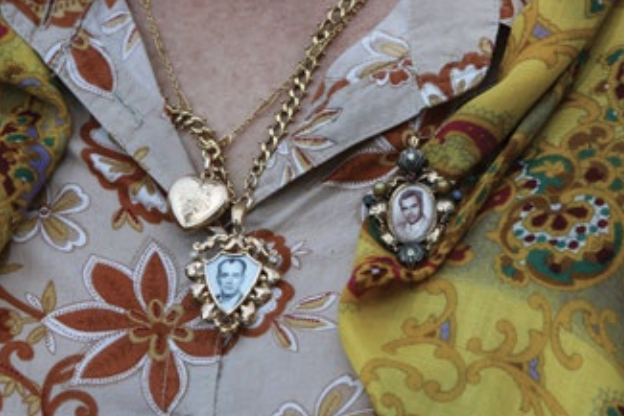
Esmaltes, from the work by Rosa Maria dos Santos Mota, published by the Municipality of Viana do Castelo, 2021.
When a daughter married, the house filled with gold
The marriage of a daughter was marked well beyond the costume. In the Minho and the Douro Litoral, festive arches were raised at the entrance to farmhouses and decorated with gold chains, a public display of the household's abundance. There was a deeper reason for all that show.
Between the middle of the nineteenth century and the middle of the twentieth, owning gold was worth as much as owning land and cattle, and more than the house one lived in. The Portuguese saying summed up the hierarchy: «terra quanta vejas, casa quanta caibas e ouro quanto possas» — as much land as you can see, as much house as you can fit into, and as much gold as you can afford. That gold was a store of value to fall back on in hard times, by selling or pawning pieces, and it was the nest egg passed down to the generations that followed. All of it was made, from the beginning, in 19.2 carat gold.
What has carried through to today
Most of this gold has left daily use and passed into the processions, into family boxes and into the Sala do Ouro of the Museu do Traje in Viana do Castelo, today the only museum space in the country devoted entirely to folk goldwork. What remained was the essential. A family still marks a marriage with a piece of gold, still chooses it with the care of someone who knows it will last, and still passes it on. The intention is the same one that led a bride to leave her house wearing three generations of gold at her chest.
Main source: Rosa Maria dos Santos Mota, «A Ourivesaria Popular Portuguesa em Viana do Castelo», published by the Municipality of Viana do Castelo, October 2021.